Tie a Strainer Knot to Join Two Fence Wires Without Losing Tension
The strainer knot joins two lengths of high-tensile wire at full strength and, tied right, holds tension while you work — the go-to splice for fence runs and brace wires.
fix a broken fence wire, tie two wires together, mend a wire fence
intermediateTools: chain wire strainer, fencing pliersAdded Jun 30, 2026
When you join two lengths of high-tensile fence wire — splicing a run or tying off a brace wire — a weak join slips under load and the whole fence loses tension. You need a splice that holds at full strength and lets you keep the wire tight while you tie it. That's the strainer knot.
The Technique
You'll need a chain-style wire strainer (tensioner) to hold tension while you work. Leave at least a foot of overlap on each wire.
Use the strainer to grab both wire ends and pull them tight, keeping at least 12 inches of overlap on each side.
In one set of jaws, form a bight (loop) in the wire, passing the working end behind the standing part. Keep the loop comfortably small — small enough to be neat, but large enough to clear the strainer jaws.
Lead the other wire through the loop, front to back.
Wind that wire up and over toward you so it wraps around the tail side of the loop, not the standing part.
Take two turns around both the tail and the standing part of the first wire.
Pull the tail straight down so it comes out of the wraps.
Take three more wraps.
Remove the excess — snap it off with the no-cut method, or cut it.
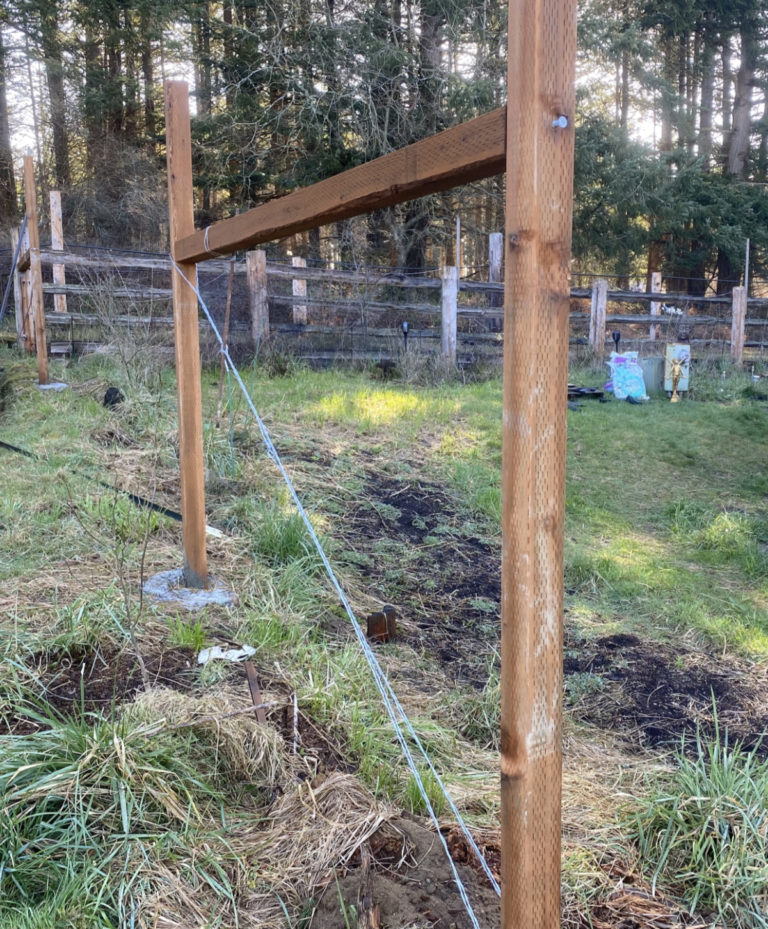
An H-brace built from 4×4 treated posts, with double-strand slick brace wire tied off using strainer knots.
Pro tip: On single-strand high-tensile wire you can snap the tail off by cranking it, no cutters needed. On stiffer double-strand "slick" wire (barbed wire without the barbs), cranking won't break it cleanly — clip it with cutters instead.
Pro tip: The strainer tool matters. A cheap big-box tensioner — like the ~$40 Goldenrod knockoffs — can start slipping on the wire after a single knot. A quality chain strainer such as the Hayes H300 holds tension reliably knot after knot and is worth the extra cost on a real fencing project.
Safety note: High-tensile wire under tension stores a lot of energy. If the strainer slips or the wire releases, the end can whip back hard. Keep your face clear of the line of the wire and wear eye protection and gloves.